
Originally published May 1, 2023 by Workers Strike Back
For decades, the labor movement has been in decline.
Last year, union membership declined to a record low – 10.1 percent.
This might be surprising. After all, unions are more popular than ever! Last year, 71 percent of Americans said they support labor unions, the highest level of support since 1965.
So why is union membership still declining?
The bosses and their political servants have always fought viciously to suppress unions. Last year, for example, Starbucks’ executives fired more than 200 union supporters in response to a wave of unionization at their stores. In December, the Democrats and Republicans teamed up to break a strike by railroad workers, who were demanding basic protections like Paid Sick Leave.
Workers and rank-and-file union members have certainly fought back in recent years–from the West Virginia teachers in 2018 to northwest carpenters in 2021, to the ongoing strike of graduate student workers at the University of Michigan.
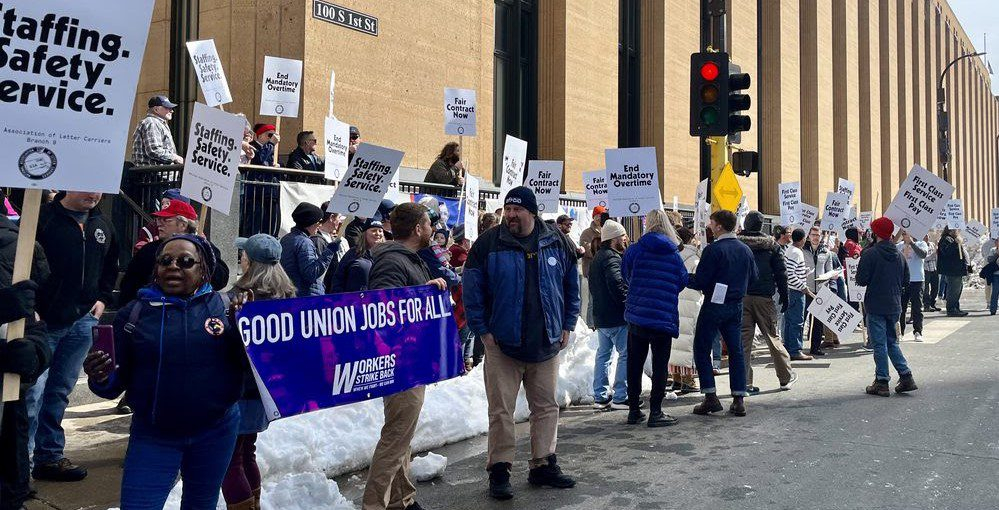
Unfortunately, many union leaders have tried to prevent workers from doing what’s necessary to overcome the opposition from the bosses, like organizing around bold demands and building strong strikes. For example, the teachers in West Virginia and the carpenters in Washington State both had to overcome the opposition of their own union leadership to go on strike.
For decades, the majority of union leaders have taken a conservative “business unionist” approach, trying to work with the bosses, instead of fighting back.
So as millions of workers begin getting organized, and as we work to rebuild strong unions, our problem isn’t just the bosses – it’s also these business unionist leaders who try to hold back the movement.
So what is “business unionism”?
The majority of union leaders today practice various forms of “business unionism.” Business unionism seeks collaboration and harmony with the bosses, instead of fighting unapologetically for what workers need.
Millions of workers have direct experience in unions run by “business unionist” leaders.
Kroger workers, represented by UFCW, are a good example. A recent survey revealed that 78 percent of Kroger grocery store workers can’t regularly afford to buy groceries for themselves.
While Kroger workers can’t afford to eat, their bosses are of course living large. The CEO of Kroger makes $20 million a year, and the company raked in over $4 billion in profits last year.
Unfortunately, the top leadership of UFCW has not been willing to do what’s necessary to take on the Kroger bosses. They have failed to mobilize the rank and file to defiant protest actions, let alone organize strikes, or put forward clear demands like a $25/hour starting wage.
And unfortunately, these union leaders are also paid vastly more than the workers they represent. In 2022, the base salary of UFCW’s International President was a whopping $298,000. Some local union presidents make even more. John Niccoli, President of UFCW Local 464 in New Jersey, took home a mind-boggling $700,941 last year, while the members he’s supposed to represent struggled to survive.
This is part of why union leaderships like that of UFCW, which represents 1.3 million workers, have a reputation among rank-and-file workers for failing to represent their members.
Working people urgently need unions, which are a vital tool to defend ourselves against the greed of the bosses. That is why Workers Strike Back is calling to unionize every workplace. But we need democratically organized unions, with accountable leaderships, which will bring the power of a united working class to bear in winning victories against exploitation by the bosses.
What we don’t need are business unionist leaders who consistently fail to fight for strong contracts for their members.
These same union leaders also dish out hundreds of millions every election cycle to support the Democratic Party. Just last week, two unions – SEIU and IBEW – scrambled to endorse Joe Biden for President less than a day after he announced his 2024 campaign, despite Biden’s role in breaking the railroad strike 6 months ago. SEIU alone spent $150 million to elect Democrats in 2020. This cozy relationship with the Democratic Party is another tell-tale sign of business unionism.

What makes a good union?
Drawing up a list of things wrong with many unions, and knowing which mistakes have contributed to the decline of organized labor, helps us to know what changes are needed to turn things around. So what makes a good union? What kind of union movement is Workers Strike Back fighting for?
- Our unions should organize around clear, bold demands, like a $30/hour starting wage and free healthcare for all.
- The strike is workers’ most powerful tool to defend ourselves from the bosses. We need to revive the strike as a key weapon of the workers’ movement.
- All union leaders should take the average wage of the members they represent. They are worker leaders, not CEOs!
- We need member-controlled unions, including open bargaining & direct elections. During a strike, when a union bargaining committee reaches a Tentative Agreement, members should be able to read the contract and vote on the picket line before ending or suspending the strike.
- Not one more penny to the Democratic Party. Unions spend hundreds of millions every election cycle on Democrats. That money should go to strike funds, organizing the unorganized, and running labor candidates outside the Democratic Party, who can prepare the ground for a new workers’ party.
We need dynamic, solidarity-based unions that are not afraid to go on strike. We need union leaders who understand that the bosses are not on our side and who will fight unapologetically for what workers need. We need unions that are independent of the Democratic and Republican Parties, because both of them are parties of big business. And we need unions with active members who are ready to organize together to transform the union movement back into a militant, fighting force that can take on the bosses and win.
We Need a Rank-and-File Rebellion
In 2021, union Carpenters in Washington went on strike, fighting against conditions that force some carpenters to live 2 hours or more outside the city where they work.
These carpenters had to fight not only the bosses, but also their own union leadership, which went to stunning lengths to weaken and sabotage the strike every step of the way. Workers courageously built their own rank-and-file organization within the union, the Peter J McGuire Group, to strengthen the strike and fight for a strong contract. They successfully organized to vote “NO” on bad contract proposals from union leadership and organized militant tactics during the strike, with the support of Councilmember Kshama Sawant.

Rank-and-file union members are increasingly fighting back against business unionist leadership.
Workers at the PCC grocery store in Seattle, who are members of UFCW 3000, have recently organized multiple pickets supported by Workers Strike Back and socialist City Councilmember Kshama Sawant, demanding a $25/hour starting wage, full staffing, and a unified wage scale for all stores. This comes in the wake of City Council Democrats, led by self-described “labor Democrat” Teresa Mosqueda, shamefully repealing the $4/hour pandemic hazard pay won by the city’s grocery workers. The UFCW 3000 leadership remained completely silent in the face of this attack by City Council Democrats, and has already endorsed Mosqueda’s campaign this year for King County Council.
Amazon workers, like those at the huge KCVG Air Hub in northern Kentucky, are organizing around bold demands like $30/hour and 180 hours Paid Time Off. Business unionists, in contrast, prefer vague demands, like a “living wage”. Of course, we do need to fight for a “living wage,” but we’re much more likely to win it if we are clear about what it means and how we can fight for it!

In multiple unions, new reform caucuses are fighting to replace the old union leadership. In the Teamsters, Sean O’Brien and the Teamsters United slate were elected last year pledging to reform the union and win a strong contract at UPS. Reformers in UAW won a similar victory last month.
In UFCW, a new caucus called Essential Workers for a Democratic UFCW is fighting for a slate of reforms that would make the union more democratic and direct more union resources towards organizing.
These reform caucuses are an important development. They reflect the desire of thousands of union members to transform our unions into fighting organizations. We need to get organized to demand that these newly-elected union leaders follow through on their promises.
In some cases, however, the leaders of these caucuses are promoting a watered-down form of business unionism. A leading figure in Essential Workers for a Democratic UFCW, for example, is none other than Faye Guenther, the President of UFCW 3000, one of the union’s leaders who allowed Seattle Democrats to repeal hazard pay for the rank and file. The union leadership also called the police on their own members last year, when a group of Kroger workers tried organizing to vote “NO” on a weak contract that gave only 15 cent raises to many workers. Guenther makes $167,000 per year.
At the national UFCW convention last week, Guenther and her caucus proposed a cap of $250,000 for union salaries. This would certainly be an improvement, as UFCW leaders nationally give themselves even more outrageous salaries. But it’s telling how out of touch many of these grossly overpaid leaders are that they would propose a cap of a quarter of a million dollars a year! Most grocery workers make a fraction of that. We need to demand that union leaders take only the average wage of the workers they represent, like ATU 1005 President Ryan Timlin in Minneapolis, or Councilmember Sawant.
If we are going to rebuild a fighting labor movement, we need to bring back the militant, class-struggle traditions that built the labor movement in the first place. We need an end to business unionism and a clean break from the rotten Democratic Party.