
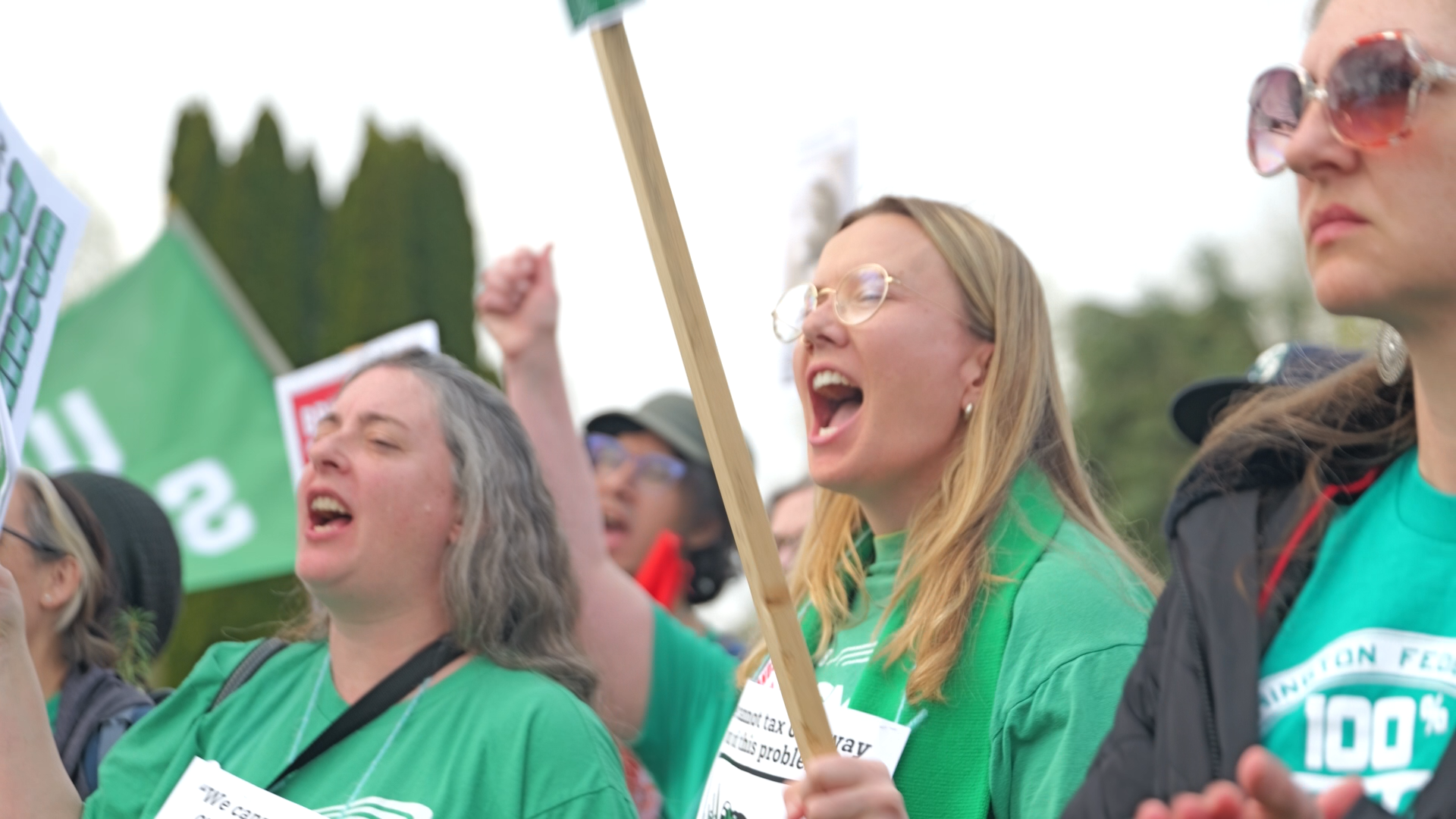
Hundreds of WFSE and other public-sector union members, Workers Strike Back members, and other working people filled the Washington State Capitol Building in Olympia on Wednesday, April 9 with chants of “No Cuts! No Furloughs! STRIKE, STRIKE, STRIKE!” to oppose $7 billion in budget cuts and anti-worker attacks proposed by state Democratic politicians.
The budget cuts proposed by the Democratic Party in Washington came on top of vicious cuts administered by Donald Trump and his 13-billionaire cabinet. Trump has fired thousands of federal workers, taken away union rights for more than a million unionized federal workers, and unleashed a wave of abductions and deportations against immigrants and antiwar activists, including union members like Kilmar Abrego Garcia, Mahmoud Khalil, Rümeysa Öztürk, and Lewelyn Dixon.
As a result of the fightback by members of the Washington Federation of State Employees union (WFSE) and other workers, including Workers Strike Back members, Democratic politicians were forced to retract some of their attacks and adjust their proposed budget. Significantly, they dropped a proposal to increase healthcare costs for public-sector workers and take away unions’ basic legal rights to fight for healthcare. In addition, the Democrats walked back the threat of furloughs, which would have amounted to a massive wage cut for state workers. These victories are a direct result of working people rallying in Olympia with open threats of strike action.
However, the final budget proposed by the Democrats and passed along with Republicans still contained many cuts to vital services totalling 2.7 billion dollars. For example, it cut childcare and early learning subsidies, and many public health services including reproductive care. These cuts have an enormous impact on working and poor people, and people will die as a result of the healthcare cuts. The so-called “fiscal crisis” that Democrats used to justify these cuts is entirely fictional: the money for these services exists, but it is hoarded by the rich. The Democrats refused to tax the 13 billionaires in Washington state who together own more than $300 billion in wealth, and instead carried out massive cuts against working and poor people.
Reversing these budget cuts and attacks on workers will take a massive fightback to tax the rich. Despite talking about such a wealth tax, WFSE union leadership never escalated and organized workers to fight for it, but instead relied on backroom negotiations with Democrats to reach a “balanced” budget. In order to fight back against budget cuts, workers must organize and use the strike, our strongest weapon. The rally in Olympia with workers threatening a strike was an important start, and won real victories, but the struggle needed to escalate. For example, coordinated sick-outs, strike action around the state, and a mass rally in Olympia involving thousands of workers would have escalated the fight to stop ALL anti-worker attacks from Governor Bob Ferguson and the Washington state Democratic Party. It is unfortunate that the union leadership not only did not organize this fightback, but even resisted calls from rank-and-file workers to do so.
The rally in Olympia was called for by rank-and-file union members like Jozi Uebelhoer, a state employee and member of Workers Strike Back and Revolutionary Workers. She put forward the original resolution in WFSE calling for a rally on April 9. This resolution passed unanimously in WFSE Local 889 and was then picked up by other union locals and rank-and-file members. The pressure from the members forced the statewide union leadership to support the rally. The strength of the April 9 rally then forced Democrats to withdraw their attacks on state workers’ healthcare. In the wake of this victory, many rank-and-file WFSE members called for a one-day, public-sector general strike to defeat all the cuts, as they had chanted in the halls of the Washington Capitol Building.
Despite this, WFSE President Mike Yestramski, the leadership of WFSE, and the statewide public-sector labor leadership refused to call for such a one-day general strike, or even a one-day sick-out. The week after the Olympia rally, Workers Strike Back members and rank-and-file WFSE members introduced resolutions in multiple WFSE union locals — WFSE Local 889 and Local 443 — calling for a one-day sick-out. In both cases, union leaders ruled the resolution “out of order” and refused to even allow members to vote on it. Instead, the leadership suggested that members call or email to appeal to the Democrats, and organized a day of writing slogans with sidewalk chalk in Democratic Governor Bob Ferguson’s neighborhood. This was a completely inadequate response.
While union leadership was stalling or outright blocking workers from building for a strike, Workers Strike Back, WFSE members and other public-sector union members, and other working people organized a meeting on April 17 to discuss building a movement for mass strikes and protests to defeat the attacks. There was overwhelming agreement that the labor movement needed to escalate in response to these attacks, but also some confusion about how to build for a real strike which reflected the bad strategies put forward by the union leadership.
For workers, strikes are not easy and are always a serious undertaking. However, when under pressure from the rank-and-file to strike, union leaders often deflect and avoid outright saying that they don’t want workers to go on strike and instead use other excuses. Often, they point to anti-strike language in union contracts, which exists in WFSE’s contract. The fact that there is anti-strike language in the contract itself shows the pitfalls of what has been a severe lack of class-struggle-based strategies among most union leaderships, both public and private sector. For decades, there has been a loss of the militant organizing that built the union movement in the first place. Instead of organizing the rank and file in a class-struggle fightback with strikes and civil disobedience, most labor leaders have capitulated to corporate bosses and their political representatives in the Democratic and Republican parties.
We need to look to militant examples, such as the West Virginia teachers’ strikes in 2018 where thousands of teachers in a Republican-dominated right to work state successfully went on strike and won real gains for teachers and students. The #RedForEd movement kicked off national waves of teachers walking out and striking in states across the country including other red states like Arizona, Oklahoma, and Kentucky.
The teachers in West Virginia built a strong strike and had to fight against the union leadership to do so. The strike was organized through Facebook and rank and file members had to force the union staff and leadership to go on strike. The success of the teachers’ strike was also due to the community and broader public sector support. They demanded a 5% raise for all public sector employees and when they were offered 5% for teachers and 3% for other public employees, the teachers stayed on the picket line until all won the full 5%. By broadening the support for their strike and fighting for more workers to win, they strengthened the #RedForEd movement.
Another common excuse for not building for a strike, is that the workers are not organized enough yet or that there simply is not enough time. These arguments are cynically self-defeating and have perpetuated the precipitous decline in the labor movement that has been happening for decades. If not now, then when? The working class will get organized for strategies that actually work. The WFSE leadership did not want to organize a rally in Olympia because they have the idea that the main way for their union to win is by working with Democratic Party politicians, even though this strategy has failed and led to losses for workers over and over again. They also thought the rally wouldn’t get enough support, but despite their mistaken lack of confidence in the working class, hundreds of workers came out to march on the legislature and threaten strike action.
The union leaders also argued that there wasn’t enough time left in the legislative session to organize a strike, which is entirely misleading. In 2014 Washington Governor Jay Inslee held a special legislative session so the state Democrats could give Boeing executives and major shareholders a nearly $9 billion tax handout—the single largest corporate giveaway in US history at the time. While this session was happening, the Boeing bosses carried out a devastating attack on the Boeing workers and the labor movement by taking away workers’ pensions in the new contract. Inslee joined in with the bosses to pressure the workers into accepting this rotten contract. If the governor can call a special session to give handouts to the rich and sell out workers, a strike can force him to call a special session to stop attacks on workers.
By undercutting public sector workers, state Democrats harmed all of Washington’s working-class and poor people. The public sector provides critical services across the state. These cuts will impact all of us, which is why the broad public and entire working class should support striking workers to fight such budget cuts. The most successful strikes in history like the Minneapolis Teamsters strike in 1934 and the Detroit sit down strikes, were made more successful because of broad public support from the entire working class.
In the 1934 Teamster strike, the workers also had to overcome bureaucratic obstacles to wage a strike. Farrell Dobbs, one of the leaders of the strike, wrote in Teamster Rebellion about how the workers dealt with entrenched union leaders who held authority despite never winning a strike. These “leaders” could be expected to be hostile toward any proposed strike action. Despite this hostility, the goal of revolutionary socialists is not simply to criticize these bureaucrats or even defeat them to win union positions, but rather more broadly to do whatever is needed to win gains for workers.
Instead of submitting to these union leaders, rank and file Teamsters like Dobbs who were ready to fight developed what they called a “flanking tactic”. Union bureaucrats are faced with a contradiction because their business unionist strategy of collaboration with the capitalists and their political servants puts them at odds with their leadership responsibilities to deliver for workers in order to maintain credibility with the union membership. As Dobbs writes, “the indicated tactic was to aim the workers’ fire straight at the employers and catch the union bureaucrats in the middle.” In order to defeat attacks on workers, we need to aim our fire at the capitalist class and their political servants in both parties, and in this way expose any weaknesses in the strategies put forward by the union leadership. That’s why WFSE members, Workers Strike Back, and working people called for a one-day public-sector general strike not just to defend against the attacks, but to go on the offensive and tax the rich to fund the services.
Unfortunately, union leaders have not done what is necessary to stop Democrats’ and Republicans’ attacks at the local and state level, or Trump’s attacks nationally. Shawn Fain and UAW leadership have not called for strike action in response to the abduction of union members like Kilmar Abrego Garcia and Mahmoud Khalil, or the retaliatory firing of local UAW President Grant Miner at Columbia. The leaderships of AFSCME, AFGE, and other government unions have not called for strike action to stop Trump’s shredding of union rights for federal workers, a move the Bezos-owned Washington Post calls the “most aggressive union-busting attempt ever.”
Workers can’t afford to wait, or to put our faith in the anti-worker courts. We need to get organized ourselves to build the fightback we need. We need all-out fights by every union and the entire workers’ movement in every state where the two parties of the billionaires are proposing budget cuts. And we will need mass strike action nationally if we are to defeat Trump’s attacks.